
Showing posts with label window sill gardening. Show all posts
Showing posts with label window sill gardening. Show all posts
Monday, September 9, 2024
Planter to hydroponics
Converted this basic planter to a hydroponics system. The base plate is cut to hold the net pots. The drain holes have to be closed with m-seal. Plants grow happily in this SIP.
 Deep water culture. Just had to add the water plus nutrients once in the whole lifetime of the plant (seed to harvest). As the roots grow the water goes down with it. This creates an air pocket which helps in air circulation.

Monday, July 22, 2024
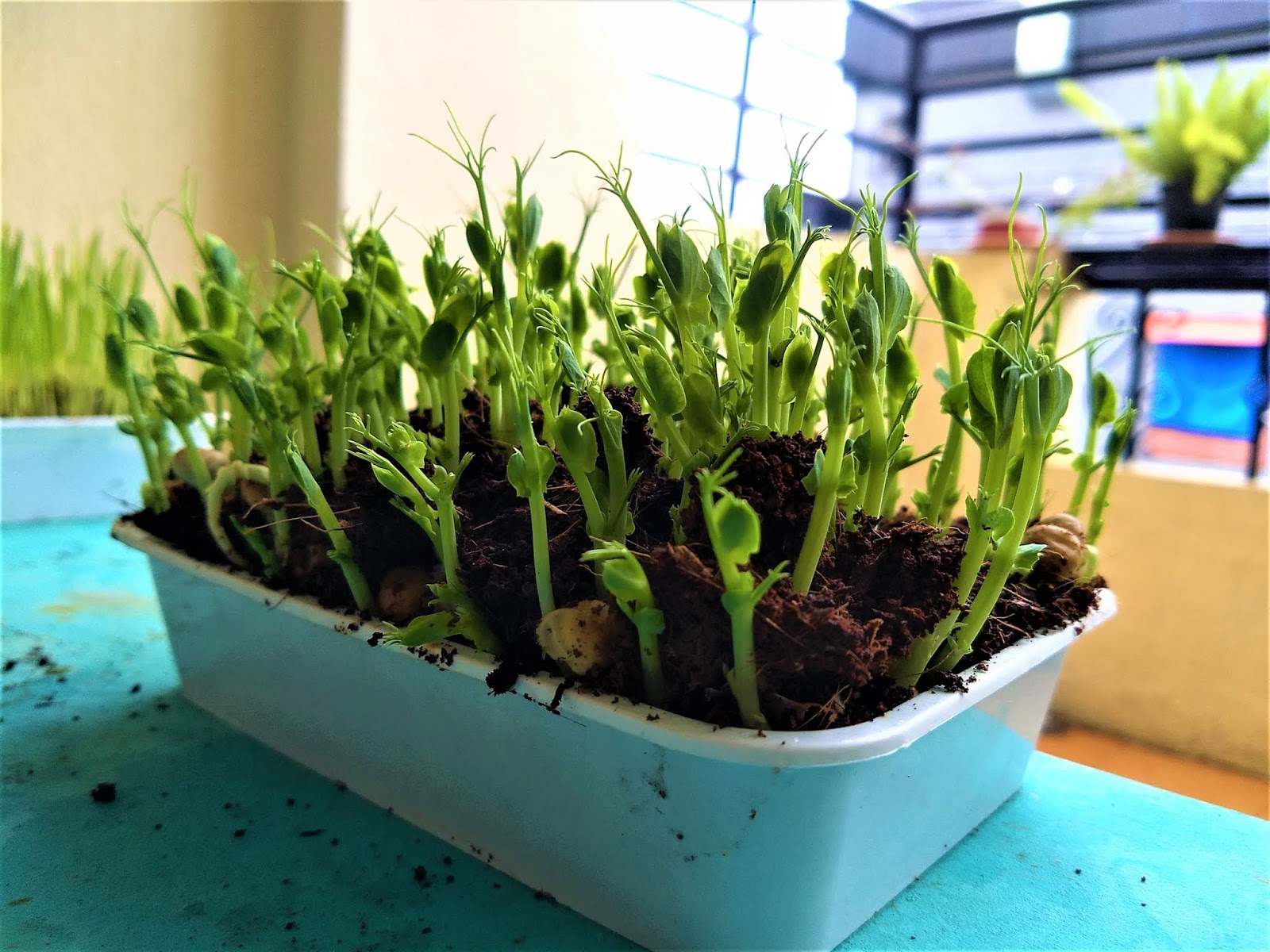
Grow yellow pea shoots
Use yellow pea shoots as an addition to salad. They are milder than the raw peas. They also don't have the lectins which is a natural toxin which is contained in the peas. You can eat the pea shoots for added protein and crunch to your food.

Saturday, June 1, 2024
Mini Hydroponics system
A friend started a mini home hydroponics system last week. Started with an ice-cream container, cutting out holes for the 2 inch netpots. Simple box cutter worked like a charm.


Holding as much as 250ml of water. This much water is sufficient for a few set of mustard. He wanted to start with something. Proposed mustard from the kitchen spice rack. Every Indian house has mustard (even if it is a bachelor's condo). Mustard greens start within 2 to 3 days.


He is happy with his greens now. Wants to grow them to fully grown mustard plans. Roots have not come out of the baskets. Some of the tiny greens are dying out. May be due to the root congestion.
Monday, March 25, 2019
Difference Between Tulsi and Basil
Main Difference – Tulsi vs Basil
Aromatic medicinal plants are primarily cultivated for the edible leaves, stems, barks, flowers or fruit components and they are essential flavoring and/or ayurvedic agents mainly used in South Asian countries. Tulsi and basil also belong to the aromatic medicinal group, and they share a similar taste profiles as well as features. As a result, tulsi is often referred to as basil or vice versa by the most of the consumers in the world. But tulsi and basil are two different plants; the botanical name of tulsi is Ocimum tenuiflorum whereas the botanical name of basil is Ocimum basilicum. Both tulsi and basil belong to the Lamiaceae family. The edible basil leaves are mainly used for culinary dishes whereas tulsi is mainly used as an indigenous medicinal ingredient. This is the main difference between tulsi and basil. Although, both tulsi and basil belong to the same family, tulsi and basil have different sensory properties as well as different applications and this article explores the difference between tulsi and basil.
What is Tulsi
Tulsi is an aromatic herbal plant, and its leaves are highly scented. It is native to the Indian subcontinent, and it is a blessed plant in Hindu belief. Hindu people believe that it as an imaginable appearance of the goddess Tulsi, a wife of the god Vishnu. Therefore, Hindu people have tulsi plants growing in the center of the central courtyard. This plant is mainly cultivated for religious and Ayurvedic medicinal purposes, and for its essential oil extraction. It is believed strongly that tulsi has health beneficial effects against headaches, inflammation, common colds, malaria and heart disease. It is also important to prevent food poisoning.

What is Basil
Basil is a culinary herb mainly used as a flavoring agent in various types of dishes in the world. Although it is originated in India, basil is mainly used in the Italian cuisine. People in Taiwan, Vietnam, Thailand and Cambodia also incorporate basil into their cooking. Leaves of basil have a pungent and strong taste.

Difference Between Tulsi and Basil
Tulsi and basil may have substantially different properties and applications. These differences may include,
Scientific Name
Tulsi is known scientifically as Ocimum tenuiflorum.
Basil is known scientifically as Ocimum basilicum.
Alternative Names
Tulsi is also known as Holy basil, Tulasi.
Basil is also known as Sweet Basil, Saint Joseph’s Wort, Thai basil, mints.
Basil grows beautifully in home hydroponics system. Basil heavily absorbs nutrient hence works best for home hydroponics with full concentration of nutrients.
Aromatic medicinal plants are primarily cultivated for the edible leaves, stems, barks, flowers or fruit components and they are essential flavoring and/or ayurvedic agents mainly used in South Asian countries. Tulsi and basil also belong to the aromatic medicinal group, and they share a similar taste profiles as well as features. As a result, tulsi is often referred to as basil or vice versa by the most of the consumers in the world. But tulsi and basil are two different plants; the botanical name of tulsi is Ocimum tenuiflorum whereas the botanical name of basil is Ocimum basilicum. Both tulsi and basil belong to the Lamiaceae family. The edible basil leaves are mainly used for culinary dishes whereas tulsi is mainly used as an indigenous medicinal ingredient. This is the main difference between tulsi and basil. Although, both tulsi and basil belong to the same family, tulsi and basil have different sensory properties as well as different applications and this article explores the difference between tulsi and basil.
What is Tulsi
Tulsi is an aromatic herbal plant, and its leaves are highly scented. It is native to the Indian subcontinent, and it is a blessed plant in Hindu belief. Hindu people believe that it as an imaginable appearance of the goddess Tulsi, a wife of the god Vishnu. Therefore, Hindu people have tulsi plants growing in the center of the central courtyard. This plant is mainly cultivated for religious and Ayurvedic medicinal purposes, and for its essential oil extraction. It is believed strongly that tulsi has health beneficial effects against headaches, inflammation, common colds, malaria and heart disease. It is also important to prevent food poisoning.

What is Basil
Basil is a culinary herb mainly used as a flavoring agent in various types of dishes in the world. Although it is originated in India, basil is mainly used in the Italian cuisine. People in Taiwan, Vietnam, Thailand and Cambodia also incorporate basil into their cooking. Leaves of basil have a pungent and strong taste.

Difference Between Tulsi and Basil
Tulsi and basil may have substantially different properties and applications. These differences may include,
Scientific Name
Tulsi is known scientifically as Ocimum tenuiflorum.
Basil is known scientifically as Ocimum basilicum.
Alternative Names
Tulsi is also known as Holy basil, Tulasi.
Basil is also known as Sweet Basil, Saint Joseph’s Wort, Thai basil, mints.
Basil grows beautifully in home hydroponics system. Basil heavily absorbs nutrient hence works best for home hydroponics with full concentration of nutrients.
Wednesday, November 28, 2018
How to Grow food in Cans

Here’s a little garden idea, an idea for a small garden, an idea for someone who knows little about gardening.
You have various cans lying around the house. Simple!
- Take a food can.
- Punch holes at the bottom.
- Fill with mix of soil manure and coco-peat.
- Water it thoroughly.
- Put some seeds available on your kitchen counter. (Coriander, fenugreek, cucumber, bittergourd or anything else)
- Place the can in sunlight or near the window.
- Water regularly.

Who says canned food is bad for you?
Subscribe to:
Posts (Atom)